Regulatory reference · FDA pages read November 4, 2026
FDA cleared vs. FDA approved: what each term means, and what neither one means.
FDA-approved is the word for drugs and for the highest-risk medical devices, which pass the FDA's strictest review, premarket approval. FDA-cleared means a device was shown, through a 510(k), to be substantially equivalent to a device already on the market, for the uses on its label. Federal rules say clearance does not in any way denote official approval. A device can be cleared for one condition and used for another; that is off-label. A use still being tested in a study is investigational.
Every definition below is quoted from the FDA, the Electronic Code of Federal Regulations or the U.S. Code as they read on November 4, 2026, with a link. General information, not legal or medical advice.
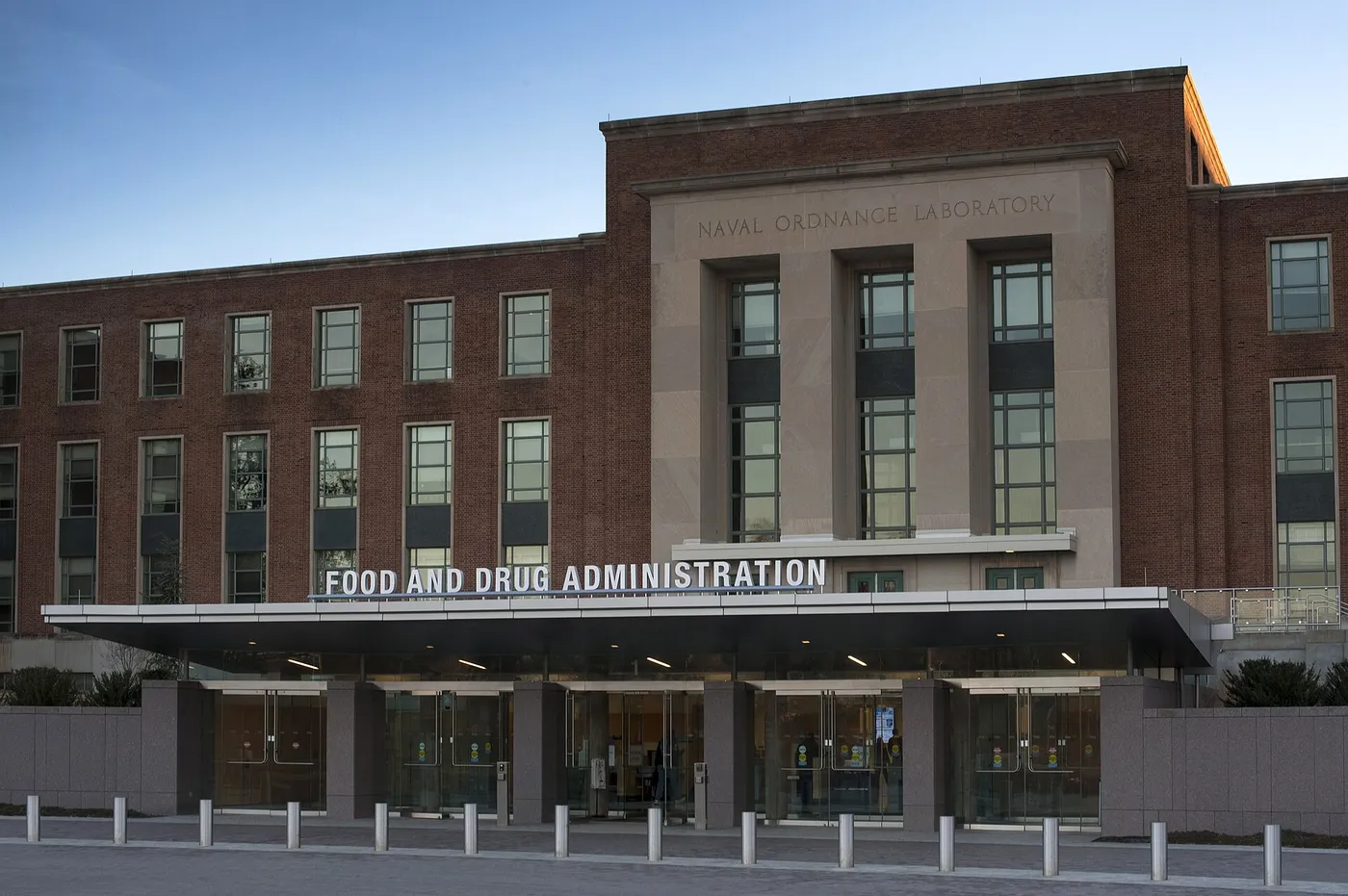
FDA Building 1, White Oak campus, Silver Spring, MD. Photo: U.S. Food and Drug Administration (2015), public domain, via Wikimedia Commons.
The terms side by side
Five FDA words people mix up, and what the FDA actually reviewed for each.
The FDA sorts devices into three classes by risk. Class I devices are the lowest risk and most need no premarket review; Class II devices are usually cleared; Class III devices usually need approval. Drugs and biologics are approved through their own applications.
FDA terms, what each applies to, the pathway behind it, what the FDA reviewed, and where to check
Term
Applies to
FDA pathway
What the FDA reviewed
FDA-approved
New drugs and biological products; the highest-risk (Class III) medical devices.
Premarket approval (PMA) for devices; a drug or biologic application for medicines.
The company's own evidence that the product is safe and effective for its intended use. For devices, the FDA calls PMA its most stringent review. PMA database
FDA-cleared
Most moderate-risk (Class II) devices and some Class I devices.
Premarket notification, called a 510(k).
That the device is substantially equivalent to a device already legally on the market (the "predicate"), for the uses on its label. 510(k) database
Granted (De Novo)
A new type of low- to moderate-risk device with no predicate to compare it to.
De Novo classification request. The FDA "grants" it and authorizes marketing.
That general controls, or general and special controls, give reasonable assurance of safety and effectiveness for the intended use. De Novo database
FDA-registered or listed
The companies that make or distribute devices, and the devices they list.
Annual establishment registration and device listing. Not a review.
Nothing about safety or effectiveness. The FDA says a registration entry does not denote approval, clearance or authorization. FDA: "FDA registered" claims
Emergency use authorized (EUA)
Unapproved products, or unapproved uses of approved ones, during a declared public health emergency.
Emergency Use Authorization, when the HHS Secretary declares the circumstances exist.
Whether set criteria are met during the emergency. The FDA says an EUA authorizes "unapproved medical products or unapproved uses of approved medical products." It is not an approval. FDA: how to check a device
What approved, cleared, granted and registered each mean.
The plain-language line is ours. The quoted line is the FDA's or the regulation's, word for word, so any site that links here can point to the source.
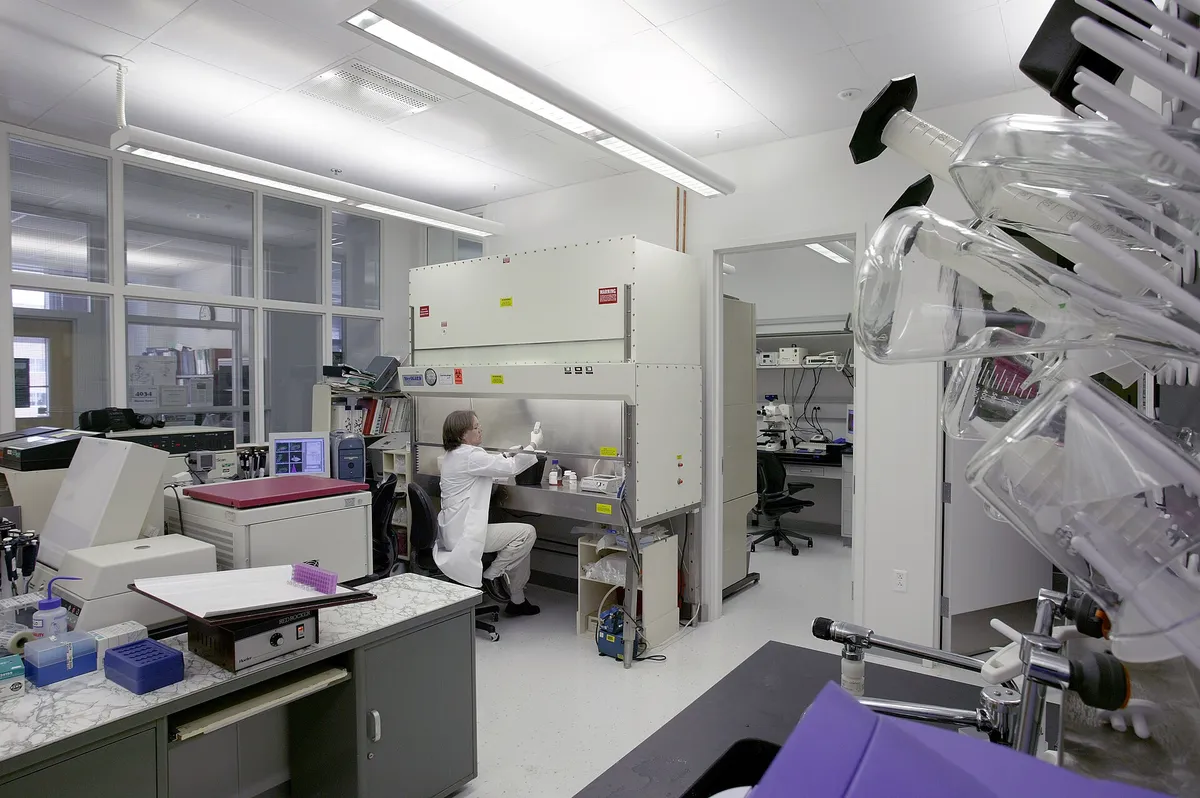
FDA Life Sciences Laboratory, Building 64, which houses the Center for Drug Evaluation and Research and the Center for Devices and Radiological Health. Photo: U.S. Food and Drug Administration (2004), public domain, via Wikimedia Commons.
FDA-approved
Approval is the FDA's strictest yes. For a device, it means a premarket approval (PMA) application: the company had to show, usually with human clinical data, that the device is safe and effective for its intended use, and the FDA agreed before the device could be sold. It is required for Class III devices, the ones that support or sustain life or carry the highest risk. Drugs and biologics are also "approved", through their own applications.
In the source's words: "PMA is the most stringent type of device marketing application required by FDA. The applicant must receive FDA approval of its PMA application prior to marketing the device."
Clearance means the FDA agreed, through a 510(k), that a device is "substantially equivalent" to one already legally on the market, for the uses written on its label. The comparison device is called the predicate. Many 510(k)s do not need new clinical trials. A cleared device is legally marketed for its cleared uses, but the law is explicit that clearance is not approval.
In the source's words: 21 CFR 807.97: a substantial-equivalence determination "does not in any way denote official approval of the device. Any representation that creates an impression of official approval of a device because of complying with the premarket notification regulations is misleading and constitutes misbranding."
When a device is new and low to moderate risk but has no predicate to be compared with, the company can ask the FDA to classify it through a De Novo request. If the FDA grants it, the device is authorized for marketing, a new device type is created, and later devices of that type can be cleared by comparing themselves to it. The FDA's own words for it are granted and authorized, not approved.
In the source's words: "The De Novo request provides a marketing pathway to classify novel medical devices for which general controls alone, or general and special controls, provide reasonable assurance of safety and effectiveness for the intended use, but for which there is no legally marketed predicate device."
Registration is a filing that companies making or distributing devices for the U.S. are generally required to make with the FDA every year. It tells the FDA who makes what. It is not a review of the product, and the FDA does not issue registration certificates. A website that shows an "FDA registration certificate" to suggest a device was reviewed is, in the FDA's words, misbranding the device.
In the source's words: "When a facility registers its establishment and lists its devices, the resulting entry in the FDA's registration and listing database does not denote approval, clearance, or authorization of that facility or its medical devices."
A cleared or approved product can still be used for something it was never cleared for.
Off-label means a legally marketed product is used for a condition, an age group, a dose or a protocol that its FDA label does not list. For devices, federal law protects that clinical choice: "Nothing in this chapter shall be construed to limit or interfere with the authority of a health care practitioner to prescribe or administer any legally marketed device to a patient for any condition or disease within a legitimate health care practitioner-patient relationship" (21 U.S.C. 396).
What off-label does not mean is that the FDA reviewed that use. The FDA's page on drugs puts it plainly: healthcare providers "generally may prescribe the drug for an unapproved use when they judge that it is medically appropriate," but "FDA has not determined that the drug is safe and effective for the unapproved use." The same holds for a device used outside its clearance.
Investigational is different again. An Investigational Device Exemption (IDE) "allows the investigational device to be used in a clinical study in order to collect safety and effectiveness data," and the FDA adds that "investigational use also includes clinical evaluation of certain modifications or new intended uses of legally marketed devices." So the same device can be cleared for one use, used off-label for a second in a clinic, and investigational for a third in a study.
TMS: one kind of device, seven FDA records, no FDA approval.
Transcranial magnetic stimulation (TMS) devices are Class II in the FDA's rules (21 CFR 882.5805 and 882.5802), so TMS reaches the market through clearance or a De Novo grant, never approval. Each record below covers one company's device for one use. Other devices have been cleared for some of the same uses since.
FDA records for TMS devices by year, use, pathway and record number
Year
Use on the FDA record
Pathway
FDA record
2008
Major depression, after at least one antidepressant did not help (the first TMS authorization for depression; a December 2008 510(k), K083538, later modified the same device)
Each record's decision letter was read on November 4, 2026. What follows for TMS and PTSD: TMS is not FDA-approved for PTSD. One system, the MeRT System, was FDA-cleared on June 3, 2026 as an add-on treatment for adults with PTSD (K260402). Another TMS device used for PTSD is used off-label, and TMS for PTSD in a research study is investigational. The status depends on the device, the protocol and the setting.
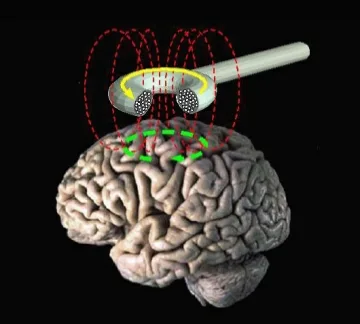
How a TMS coil works: its magnetic field (red) induces a small current (green) in the brain beneath it. NIH illustration by Eric Wassermann, M.D. (2009), public domain, via Wikimedia Commons.
Check it yourself
Five steps to find out what the FDA actually said about a device.
Every FDA decision on a device is public. These steps take a few minutes and settle most questions about whether a claim on a website is accurate.
01
Find the exact device, not the treatment
Search the device name or the company in Devices@FDA, which covers approved and cleared devices. A De Novo device is in the separate De Novo database. Clearance belongs to one device from one company, not to a whole kind of treatment.
Open the decision letter and read "Indications for Use"
The database entry links the FDA's decision documents. Find the indications for use: the exact use, age group and setting the FDA cleared, granted or approved. Words like "adjunct" (add-on) and an age range matter.
Match the use you are being offered to that wording
Same device, same condition, same population, same protocol: that is the cleared or approved use. A different condition, age or protocol is off-label, even on a cleared device.
04
Ask whether it is part of a study
If the use is being tested, it is investigational. The FDA notes that device studies are also monitored by an institutional review board (IRB) at the hospital or facility running them.
Ignore registration numbers and certificates as proof
A registration number or a certificate with the FDA logo says nothing about whether the FDA reviewed the product. The FDA does not issue device registration certificates.
Six claims to avoid, and the accurate version of each.
Regulatory words on a practice website are claims. Here are six common ones, with the wording that matches the FDA record and the reason, so every page that links here uses the same language.
Instead of "FDA-approved TMS" (or any 510(k) or De Novo device called "approved")
Say: "FDA-cleared for [the use on its label]", naming the device. For a De Novo device: "FDA-authorized (De Novo) for [use]".
Why: 21 CFR 807.97 calls a claim of official approval based on a 510(k) misleading and misbranding.
Instead of "FDA-approved for PTSD" when only one device is cleared for that use
Say: "Not FDA-approved for PTSD. One system, [device], is FDA-cleared as [the exact use]; other devices used for PTSD are used off-label."
Why: Clearance covers one device and one wording of use. The rest of the category does not inherit it.
Instead of "FDA-cleared treatment" for a use that is not on the label
Say: "[Device] is FDA-cleared for [cleared use]. Using it for [other condition] is off-label: the FDA has not reviewed it for that use."
Why: A clinician may use a legally marketed device off-label within a legitimate practitioner-patient relationship (21 U.S.C. 396), but the FDA has not reviewed that use.
Instead of "FDA-registered device" or a registration certificate used as a seal of quality
Say: Leave registration out of patient-facing claims, or say what it is: "The manufacturer is registered with the FDA, which is not a review of the device."
Why: The FDA says registration does not denote approval, clearance or authorization.
Instead of "FDA-approved clinic" or "FDA-approved provider"
Say: Describe the product's status, not the practice's.
Why: The FDA states that it does not approve health care providers, including physician offices.
Instead of "available" or "proven" for a use still being studied
Say: "Investigational: being studied in [the named study]", and nothing that suggests the result is known.
Why: Investigational use is the FDA's term for clinical testing of a device or a new use.
The FDA's consumer update says it plainly: "The FDA does not 'approve' health care providers, including physician offices or laboratories."
Short answers, each one traceable to a source above.
01
Is FDA cleared the same as FDA approved?
No. FDA-approved, for a device, means the FDA reviewed a premarket approval (PMA) application, its most stringent review, usually for Class III devices. FDA-cleared means the FDA found through a 510(k) that the device is substantially equivalent to a device already legally marketed. Federal rules (21 CFR 807.97) say a 510(k) clearance does not in any way denote official approval, and calling a cleared device approved is misleading.
02
Which is stricter, FDA clearance or FDA approval?
Approval. The FDA calls premarket approval the most stringent type of device marketing application. It requires sufficient valid scientific evidence that the device is safe and effective for its intended use. Clearance compares a device with an existing one, and the FDA notes that only a small percentage of 510(k)s need clinical data.
03
What does FDA granted mean?
It means the FDA granted a De Novo request for a new type of low- to moderate-risk device that has no predicate. The device is authorized for marketing, a new classification regulation is created, and future devices of the same type can use it as a predicate for a 510(k).
04
What does off-label mean for a medical device?
It means a legally marketed device is used for a condition, age group or protocol its FDA clearance or approval does not list. Federal law (21 U.S.C. 396) does not limit a health care practitioner's authority to use a legally marketed device for any condition within a legitimate practitioner-patient relationship. It also means the FDA has not reviewed the device for that use.
05
Can a doctor use an FDA-cleared device for a condition it is not cleared for?
Yes, within a legitimate practitioner-patient relationship; 21 U.S.C. 396 protects that clinical judgment. The use is off-label, so the FDA has not determined that the device is safe and effective for it.
06
What does investigational mean?
It means the device, or a new use of an already marketed device, is being tested in a clinical study to collect safety and effectiveness data. The FDA says investigational use includes clinical evaluation of new intended uses of legally marketed devices.
07
Is TMS FDA-approved?
No. TMS devices are Class II devices in the FDA's rules, so they reach the market through 510(k) clearance or a De Novo grant, not approval. Specific TMS systems are cleared or granted for specific uses, including major depression (2008), migraine pain (2013), OCD (2018), smoking cessation (2020), depression with anxiety symptoms (2021), depression in people aged 15 to 21 (2024) and, for one system, PTSD (2026).
08
Does "FDA registered" mean the FDA approved a product?
No. Registration and listing tell the FDA who makes a device. The FDA says the entry does not denote approval, clearance or authorization, and that it does not issue device registration certificates.
09
How do I check whether a device is FDA-cleared or approved?
Search Devices@FDA by device or company name, and the De Novo database for newer device types. Open the decision letter and read its Indications for Use, then compare that wording with the use you are being offered.
Regulatory wording on a practice site
Health websites where every FDA word traces to the FDA record.
Treatment pages, device pages and comparison guides all make regulatory claims. How we build healthcare websites, including the claims a site refuses to make without proof, is on the medical and healthcare website design page.